

Halter production · matched connections
Matched Halter Hardware for Each Strap Junction
Choose halter hardware by the strap route, then coordinate its appearance. Put a buckle or junction at each position and compare it with the finished strap width and fold. Counting those selected parts gives you a clear hardware set for the actual halter layout, with individual spares available as separate enquiry lines.
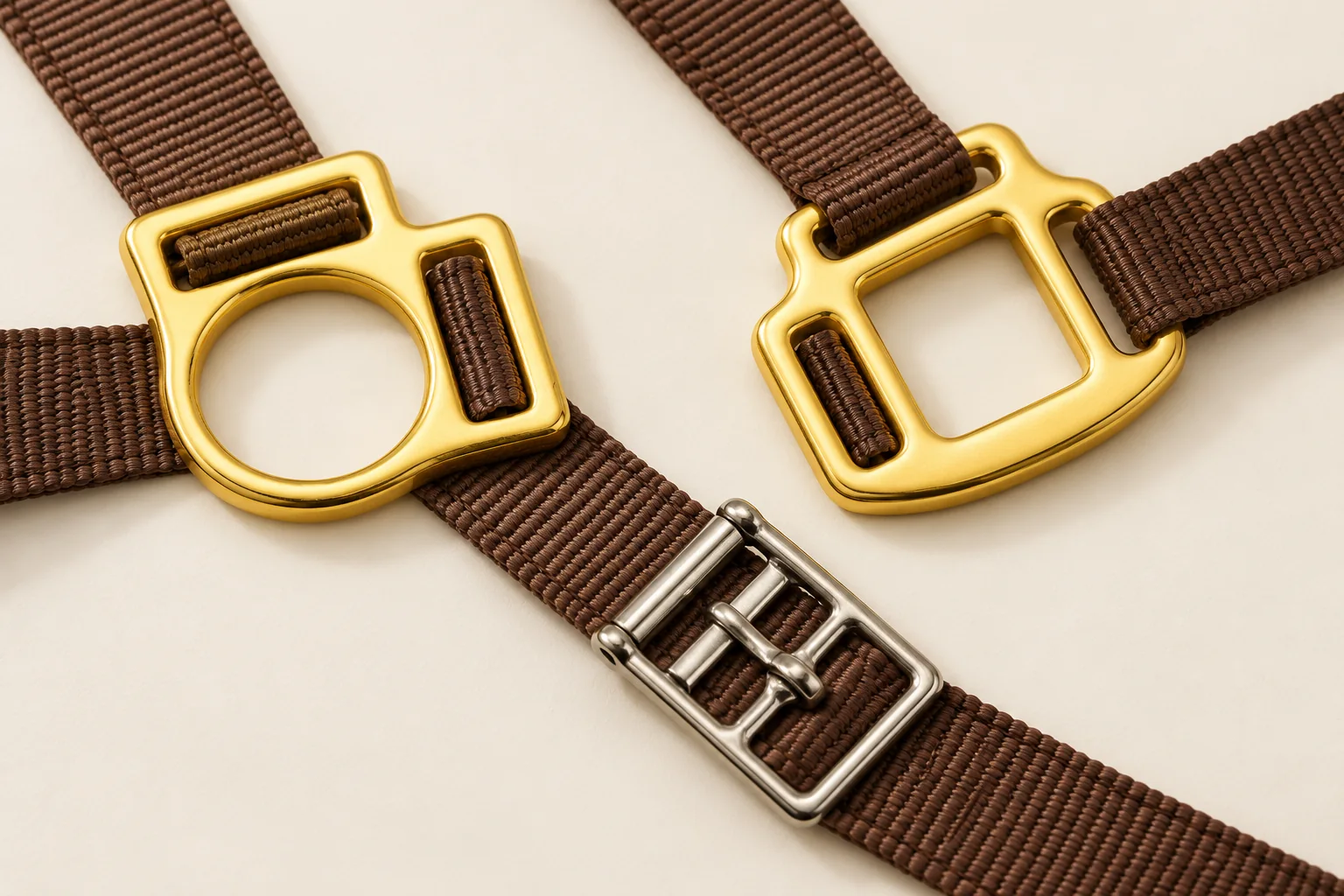
- Map the strapsGive every junction a position.
- Compare the passagesInclude folded strap thickness.
- Count the partsDefine your own assembly schedule.
Choose for your application
Give each fitting a job on the halter
Relia can discuss brass buckle and junction references, a stainless roller and a separate three-way ring form. Mark the strap route first, then choose a fitting and size for each position before coordinating the overall appearance.
Match construction to position
- Adjustment pointChoose the closure and its strap width.
- Direction changeChoose the junction geometry for the strap route.
- Attachment foldInclude the finished layers at each opening.
Read the design and specification notes
At Relia, YF10118B and YF10145B provide brass starting points, while YF103022SS offers a separate stainless roller route. The three-way ring form changes the junction geometry again. Mark the adjustment point, each direction change and the strap width at that position. We can discuss the named fittings around that layout, with their individual quantities and appearance choices still clear.
A closer product look
Keep the three-slot model separate from its family
Choose the 1-inch YF10145B when its Brass/Solid Brass construction, antique-brass appearance and three-slot layout suit your webbing junction. Mark the strap route and required opening on its drawing before confirming the sample.
Confirm YF10145B on its own drawing; request separate slot dimensions for any selected HL10146B or HL10147B.
Identify one junction version
- Selected model
- YF10145B carries the 1-inch option.
- Slot arrangement
- Compare the actual openings with the halter route.
- Family variants
- Use a separate slot drawing for each selected HL10146B or HL10147B.
Read the design and specification notes
For the 1-inch YF10145B, keep Brass/Solid Brass and the Antique brass finish with the selected slot arrangement. When considering HL10146B or HL10147B and the 3/4-inch or 1-inch choices, request the size and opening drawing for each selected code. Compare each fitting with the actual webbing route and folded layers.

Construction and making
Compare the finished slot where the strap passes
For cast multi-slot parts, windows and draft affect where an opening is measured; trimming and polishing affect its contact edges. Define that finished passage instead of relying on outside width. The selected forming route still needs agreement.
Agree the selected fitting's forming route and the finished usable passage at each strap contact.
Link the opening to the finished strap
- Window formationDefine the measuring position within the slot.
- Edge finishingCompare the boundaries that touch the strap.
- Threaded assemblyInclude the folded layers that use the passage.
Read the design and specification notes
For a cast multi-slot fitting, the windows affect filling and release from the mould; draft means an opening needs a defined measuring position. Trimming and polishing then matter at the edges touching the strap. This explains why outside width and nominal strap size cannot replace a finished slot view. The actual casting or other forming route for the selected brass and stainless parts must be aligned before describing their production sequence.
| Production stage | Finished feature | Buying consequence |
|---|---|---|
| Opening formation | Slot walls and measuring plane | Compare the passage used by the strap |
| Trimming and finishing | Contact edges around each slot | Include the completed folded attachment |
| Assembly layout | Fitting at each direction change | Keep material, size and count by position |
Share the product link and your intended use, with these details:
- Halter strap-route drawing with adjustment and junction positions
- Finished strap widths, thicknesses and folded attachment views
- Selected model, size, appearance and quantity at each position
A closer product look
Choose the buckle for the adjustment point
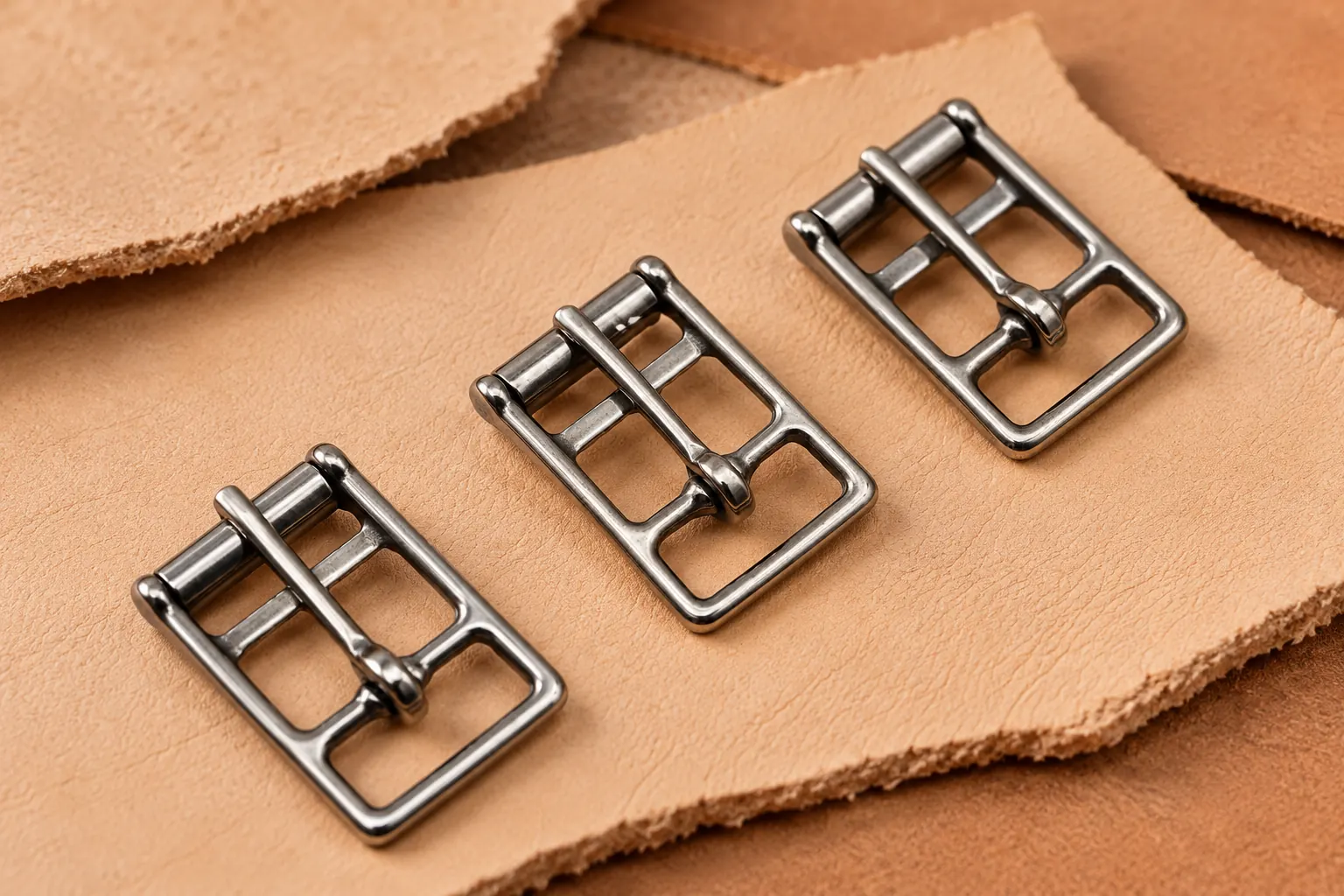
The nominal 3/4-inch brass YF10118B and 1-inch stainless YF103022SS are different adjustment configurations. Choose the required strap relationship first; material or a coordinated finish cannot remove the difference in their nominal width families.
Compare adjustment constructions
- Brass buckle
- YF10118B: nominal 3/4 inch, antique-brass appearance.
- Stainless roller
- YF103022SS: nominal 1 inch, Bright Nickel option.
- Finished strap
- Compare the actual fold and closure, not width alone.
Read the design and specification notes
YF10118B provides a Brass 3/4-inch buckle reference with Antique brass finish. YF103022SS provides a Stainless Steel 1-inch roller reference with Bright Nickel. Compare these as different adjustment configurations; neither material choice nor a coordinated colour makes their strap widths interchangeable.
Choose for your application
Coordinate appearance without losing the material choice
You can discuss an antique-brass-looking group or a different stainless roller specification. Keep each base material and appearance on separate lines so the visual range remains tied to identifiable parts and their individual fit requirements.
Keep two choices beside every part
- Base componentName the model and intended strap position.
- MaterialRetain the stated material for that component.
- AppearanceSelect its finish independently of material and fit.
Read the design and specification notes
The three-slot and buckle references can support an antique-brass-looking range, while a stainless roller can form a different specification. List material and finish independently for every item. This makes it easier to discuss a visual set without losing the identity of its individual components.
A closer product look
A three-way ring changes the junction layout
The three-way ring form has a circular centre and rectangular passages, unlike a three-slot junction. Give its nominal 3/4-inch or 1-inch option a separate position on the drawing rather than substituting it because the appearance coordinates.
Confirm the material and actual passages of the chosen three-way ring.
Compare geometry before substitution
- Centre formAllow for the circular junction layout.
- Strap passagesMap each rectangular opening to its strap direction.
- Selected sizeKeep the nominal option with the marked position.
Read the design and specification notes
The three-way ring fitting offers 3/4-inch and 1-inch size labels. Its circular centre and rectangular strap passages present a different layout from a three-slot junction. Give it its own dimensioned position in the halter drawing rather than substituting it solely because the colour is similar.

Choose for your application
Count a set from the intended layout
A useful set is a bill of parts for your halter: selected model, size and quantity at every position. The same family can serve different layouts; a photograph does not define a fixed-count supplied kit.
Turn positions into a parts schedule
- PositionName the adjustment or junction location.
- PartAssign the selected model and size.
- QuantityCount that fitting in the intended assembly.
Read the design and specification notes
The layout determines how many buckles and junctions the intended halter uses. Record a bill of parts with the selected size at each location. This allows the same hardware family to be discussed for different halter layouts without implying that every photograph shows a fixed-count complete kit.
| Part | Choose by | Count basis |
|---|---|---|
| YF10118B | 3/4-inch adjustment | Buckle positions |
| YF10145B | Selected junction geometry | Strap intersections |
| YF103022SS | 1-inch roller route | Alternative adjustment |
| Three-way ring fitting | Three-way ring layout | Specified positions |
Choose for your application
Show the folds beside the junctions
A strap mock-up makes the relationship easier to discuss: opening, folded layers and stitch or fixing area stay visible together. Use it to locate any clearance question before treating a coordinated group as an agreed assembly.
Expose the space used by the strap
- OpeningShow where the strap enters the fitting.
- Return foldInclude every finished layer at the attachment.
- Fixing areaShow the stitch or other fixing relationship.
Read the design and specification notes
Show the finished folds, stitch or fixing areas and the strap route beside each fitting. Compare the space used by those layers with the actual opening at every junction. This makes any extra clearance requirement visible before the coordinated group is agreed.
Products behind these choices
3/4 Inch Brass Horse Halter Buckle - Antique Brass Finish
Compare the nominal 3/4-inch brass buckle at the adjustment point.
View this product →YF10145B Antique Brass Finish Three-Slot Webbing Fitting with 1-Inch Label for Horse Halter Enquiries
Map a 1-inch YF10145B three-slot junction to its actual position.
View this product →Stainless Steel Roller Buckle, Bright Nickel, Nominal 1 Inch
Compare the nominal 1-inch stainless roller as a separate closure route.
View this product →Alloy Three Way Ring Strap Fitting, 3/4in and 1in References
Compare the circular-centre three-way junction with the strap layout.
View this product →Start a product discussion
Send the position-by-position halter brief
Send the halter layout with finished strap widths and folds, then name and count the fittings required at each position. Add the material and appearance choices for those parts. We can discuss a coordinated, explicitly counted group for your selected halter.
Qingdao Relia Saddlery Co., Ltd.Changjiang Road, Qingdao, Shandong, ChinaProduct discussion details
Prepare a matched-hardware enquiry
- Show the routeMark every adjustment and direction change.
- Describe the strapInclude finished width and folded layers.
- Assign the partsName model, size, appearance and count per position.